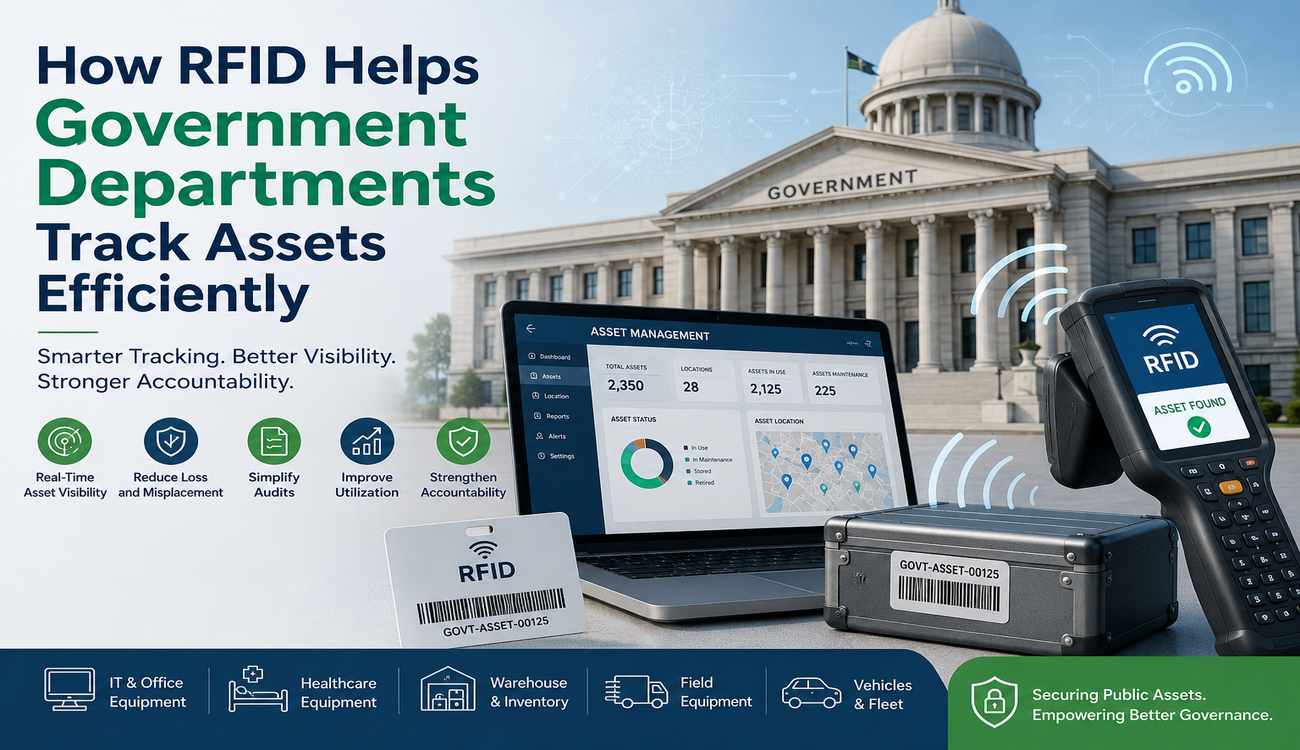
Government departments manage thousands of physical assets across offices, hospitals, schools, public infrastructure, transportation facilities, warehouses, and field operations. Keeping track of these assets manually can become difficult as the number of equipment, vehicles, tools, documents, and other resources continues to grow. Assets can be misplaced, transferred without proper records, underutilized, or even lost when departments rely heavily on spreadsheets, paper registers, and manual verification.
This is where RFID Government Asset Tracking can make a significant difference. Radio Frequency Identification (RFID) technology enables government organizations to identify, monitor, and manage assets using RFID tags and readers. Instead of depending entirely on manual data entry, departments can automatically capture asset information and maintain more accurate records across different locations.
With RFID-based asset tracking, government departments can improve visibility, strengthen accountability, reduce administrative work, and make better decisions about how public resources are being used.
Understanding RFID Government Asset Tracking
RFID Government Asset Tracking uses radio frequency technology to identify and monitor government-owned assets. An RFID system generally consists of RFID tags, RFID readers, antennas, asset management software, and a centralized database.
An RFID tag is attached to an asset and contains a unique identification number. When the tagged asset comes within the reading range of an RFID reader, the reader captures the tag information and sends it to the connected software. The system can then record details such as the asset’s location, movement, status, assigned department, and other relevant information.
How RFID Identification Works
Unlike traditional barcodes, RFID tags do not always need to be directly visible to the reader. Multiple tags can also be detected within a reading area, depending on the type of RFID technology and system configuration. This makes RFID particularly useful for government environments where large numbers of assets need to be verified or moved between locations.
For example, a government warehouse may contain hundreds of computers, networking devices, medical supplies, tools, or maintenance equipment. Instead of manually checking each asset and recording its identification number, RFID readers can help capture information more efficiently and update the asset management system.
Why Government Departments Need Better Asset Tracking
Government departments operate under strict requirements for accountability and responsible use of public resources. Assets may be distributed across multiple offices, districts, warehouses, field locations, and facilities. Maintaining accurate information across all these locations can be challenging when departments depend on manual processes.
Reducing Asset Misplacement
Assets can easily be misplaced when employees or departments move equipment without updating records. A missing laptop, medical device, tool, or communication system may not be discovered until an audit or physical verification exercise takes place.
RFID tracking provides better visibility into asset movement. When an RFID-tagged asset passes through a monitored location, the system can capture its identification and update its movement information. This can help departments identify where an asset was last recorded and reduce the time required to search for missing equipment.
Improving Accountability
Public assets need to be properly assigned and maintained. Government organizations can use RFID systems to maintain digital records showing which assets belong to a particular department, facility, employee, or operational unit.
This creates a clearer chain of accountability. When an asset is transferred, issued, returned, or relocated, the corresponding record can be updated in the system, helping departments maintain more reliable asset histories.
Key Applications of RFID in Government Asset Management
RFID can be applied across different government functions because almost every department manages physical resources that require identification, movement tracking, or periodic verification.
Tracking IT and Office Equipment
Government offices typically manage computers, laptops, printers, servers, networking equipment, projectors, furniture, and other assets. Managing these resources across multiple departments can become complicated, especially when equipment is frequently transferred or replaced.
RFID tags can provide each asset with a unique digital identity. Departments can use the system to maintain information about acquisition, assignment, location, maintenance, and disposal. This makes it easier to conduct physical verification and identify discrepancies between recorded and actual assets.
Managing Healthcare Equipment
Government hospitals and healthcare facilities manage a large range of expensive equipment, including diagnostic machines, patient monitoring devices, wheelchairs, beds, infusion equipment, and laboratory instruments.
RFID can help healthcare administrators identify equipment and improve visibility across departments. Staff can locate equipment more quickly and monitor whether devices are available, assigned, undergoing maintenance, or stored in another area.
This can also help reduce unnecessary purchases when existing equipment is available but difficult to locate.
Government Warehouses and Stores
Warehouses operated by government departments may contain thousands of items that need to be received, stored, transferred, and issued. Manual inventory checks can consume significant time and may introduce data-entry errors.
RFID enables faster identification of tagged items and can support automated inventory processes. When integrated with warehouse management software, RFID data can help maintain updated records of stock and equipment moving through government storage facilities.
Tracking Field Equipment
Many government departments operate outside traditional office environments. Public works, transportation, utilities, emergency services, and infrastructure departments may deploy equipment to construction sites, roads, inspection locations, and other field environments.
RFID can help organizations maintain records of equipment assigned to field teams and track when those assets are returned or transferred. This creates better control over equipment that frequently moves between locations.
How RFID Improves Government Asset Visibility
One of the biggest advantages of RFID Government Asset Tracking is improved visibility. Traditional asset registers often provide information about what an organization owns but may not provide timely information about where those assets are currently located.
Creating a Centralized Asset Record
An RFID-enabled asset management platform can connect asset identification data with a centralized database. Departments can maintain information about an asset throughout its lifecycle, from procurement to deployment, maintenance, transfer, and retirement.
Having a centralized record makes it easier for authorized personnel to access consistent asset information and reduces dependency on separate spreadsheets maintained by individual teams.
Supporting Real-Time or Near Real-Time Monitoring
Depending on the RFID system architecture, departments can monitor asset movements as tagged items pass through designated reading zones. This can be particularly useful for high-value equipment and assets that frequently move between controlled areas.
Instead of discovering movement during a monthly or annual audit, departments can receive information closer to the time when the movement occurs.
RFID and Government Asset Audits
Asset audits are an important part of government financial and administrative management. However, physical verification can be time-consuming when every asset must be located and checked manually.
Faster Physical Verification
RFID readers can scan multiple tagged assets without requiring employees to manually record every identification number. This can significantly reduce the effort involved in inventory verification.
For large government facilities, RFID-based verification can make periodic audits more efficient while helping teams identify assets that are missing, relocated, or incorrectly recorded.
Identifying Record Discrepancies
When RFID data is compared with the organization’s asset database, departments can identify differences between registered assets and physically detected assets. These discrepancies may indicate unrecorded transfers, missing equipment, incorrect locations, or outdated records.
This gives administrators an opportunity to correct asset information and improve the accuracy of government inventories.
Integrating RFID With Government Software Systems
RFID becomes more valuable when it works alongside existing government applications rather than operating as an isolated technology.
Integration With ERP and Asset Management Systems
Government departments may already use ERP platforms, inventory management software, financial systems, procurement applications, or custom asset management platforms. RFID data can be integrated with these systems to reduce duplicate data entry and create a more connected asset management process.
For example, when a newly purchased asset receives an RFID tag, its unique identification can be connected with procurement and financial information. As the asset moves through different departments, its location and status can be updated within the broader asset management environment.
Connecting RFID With IoT Technologies
RFID can also work alongside IoT sensors, GPS, BLE, cloud platforms, and other technologies. Each technology serves a different purpose, and combining them can provide a more comprehensive view of government resources.
RFID can identify an asset, while IoT sensors can provide information about environmental conditions or equipment status. GPS can support outdoor location tracking, while centralized software can bring the collected information together for administrators.
Security and Data Management Considerations
Government asset tracking systems handle operational and organizational information, so security should be considered during implementation. RFID deployments should use appropriate access controls, secure data transmission, user authentication, and system monitoring.
Controlling Access to Asset Information
Not every employee needs access to every asset record. Role-based access can help ensure that personnel only see or modify information relevant to their responsibilities.
Audit logs can also help administrators understand who accessed or changed asset records, supporting greater accountability and system governance.
Protecting the RFID Infrastructure
RFID readers, connected software, databases, and network infrastructure should be protected against unauthorized access. Government departments should evaluate the security requirements of the entire system rather than treating RFID tags as the only security consideration.
Benefits of RFID Government Asset Tracking
The adoption of RFID can provide government departments with measurable operational benefits. Automated identification reduces the amount of manual work involved in tracking physical assets, while centralized information improves visibility across locations.
Departments can potentially reduce asset losses, improve utilization, accelerate audits, strengthen accountability, and make more informed purchasing decisions. Better visibility can also help organizations identify underused resources and redistribute them instead of purchasing additional equipment unnecessarily.
Over time, accurate asset histories can support better maintenance planning and lifecycle management. Government organizations can understand how assets are being used, when they require servicing, and when replacement or retirement may be appropriate.
Challenges to Consider During RFID Implementation
Although RFID offers significant benefits, successful implementation requires careful planning. Government departments often operate complex environments with different facilities, legacy software, procurement procedures, and operational requirements.
Choosing the Right RFID Technology
RFID is not a single technology with identical performance in every environment. Passive and active RFID systems have different characteristics, and factors such as reading distance, asset material, environmental conditions, and required accuracy can influence the choice.
Departments should evaluate the actual tracking environment before selecting tags and readers.
Managing Legacy Systems
Integration with existing government applications can be another challenge. Older systems may not have modern APIs or integration capabilities. A phased implementation and proper technical assessment can help organizations connect RFID data with existing workflows without unnecessarily disrupting operations.
Training Employees
Technology alone cannot solve asset management problems if employees do not use the system correctly. Government departments should provide appropriate training and establish clear processes for tagging, transferring, returning, maintaining, and retiring assets.
The Future of RFID in Government Asset Management
The role of RFID in government asset management is likely to become more connected as organizations adopt cloud platforms, IoT, analytics, and automation. Future systems can combine RFID identification with data analytics to provide deeper insights into asset utilization and operational efficiency.
Moving From Asset Tracking to Asset Intelligence
The next stage of asset management is not simply knowing where an asset is. Government organizations can use collected data to understand how assets are being used and where resources can be optimized.
For example, historical asset movement data could help departments identify frequently transferred equipment, underutilized resources, or locations with unusually high equipment demand. These insights can support procurement planning and resource allocation.
Supporting Smarter Public Services
Better asset management ultimately contributes to better public services. When government departments can locate equipment quickly, maintain resources properly, and reduce unnecessary asset purchases, they can use public funds more efficiently.
RFID therefore has value beyond inventory management. It can become part of a broader digital transformation strategy focused on improving operational transparency, resource utilization, and service delivery.
Conclusion
RFID Government Asset Tracking provides government departments with a practical way to improve how physical assets are identified, monitored, verified, and managed. By replacing many manual tracking activities with automated identification, RFID can help organizations gain better visibility while reducing administrative effort.
From government offices and warehouses to hospitals and field operations, RFID can support a wide range of asset management requirements. When integrated with ERP platforms, asset management software, IoT technologies, and secure digital infrastructure, RFID can create a more connected approach to managing public resources.
For government organizations looking to improve accountability, asset utilization, audit efficiency, and operational visibility, RFID can serve as an important technology layer in the journey toward smarter and more efficient asset management.
FAQs
Q1. What is RFID Government Asset Tracking?
RFID Government Asset Tracking is a technology-based approach that uses RFID tags and readers to identify, monitor, and manage government-owned assets. It helps departments maintain accurate information about asset locations, movements, assignments, and status.
Q2. How does RFID help government departments track assets?
RFID allows departments to automatically identify tagged assets when they pass within the reading range of an RFID reader. This reduces manual data entry and helps organizations maintain more accurate records of asset movement, location, and usage.
Q3. What types of government assets can be tracked using RFID?
RFID can be used to track office equipment, IT devices, medical equipment, tools, warehouse assets, vehicles and field equipment, furniture, and other valuable government resources. The appropriate RFID technology depends on the type of asset and tracking environment.
Q4. Can RFID asset tracking integrate with existing government software?
Yes. RFID systems can be integrated with ERP platforms, inventory management systems, asset management software, procurement applications, and other government applications. This allows RFID data to become part of existing asset management workflows.
Q5. What are the main benefits of RFID Government Asset Tracking?
RFID Government Asset Tracking can improve asset visibility, reduce misplacement and losses, simplify physical audits, strengthen accountability, reduce manual work, and help government departments make better decisions about asset utilization, maintenance, and procurement.