Modern businesses depend on accurate asset visibility to maintain operational efficiency, reduce equipment loss, and improve resource utilization. In industries such as manufacturing, healthcare, logistics, automotive, and warehousing, knowing the exact location of critical assets can make a significant difference in productivity and decision-making. Traditional tracking methods, including barcodes, RFID, GPS, and Bluetooth, offer useful capabilities, but they may not provide the level of indoor positioning accuracy required for complex operational environments. This is where UWB RTLS technology becomes valuable.
Ultra-Wideband (UWB) Real-Time Location Systems (RTLS) combine wireless communication and precise distance measurement to identify the location of tagged assets within a defined area. Unlike conventional indoor tracking solutions that may struggle with accuracy in crowded or obstructed environments, UWB-based systems can deliver highly precise positioning when properly designed and deployed. Organizations can use this technology to track tools, machinery, medical equipment, inventory, vehicles, and other valuable resources in real time.
Understanding how UWB positioning works, where it delivers the greatest value, and what businesses should consider before implementation can help organizations make informed technology decisions. This guide explores the fundamentals, benefits, applications, implementation process, and future potential of high-precision asset tracking.
What Is UWB RTLS?
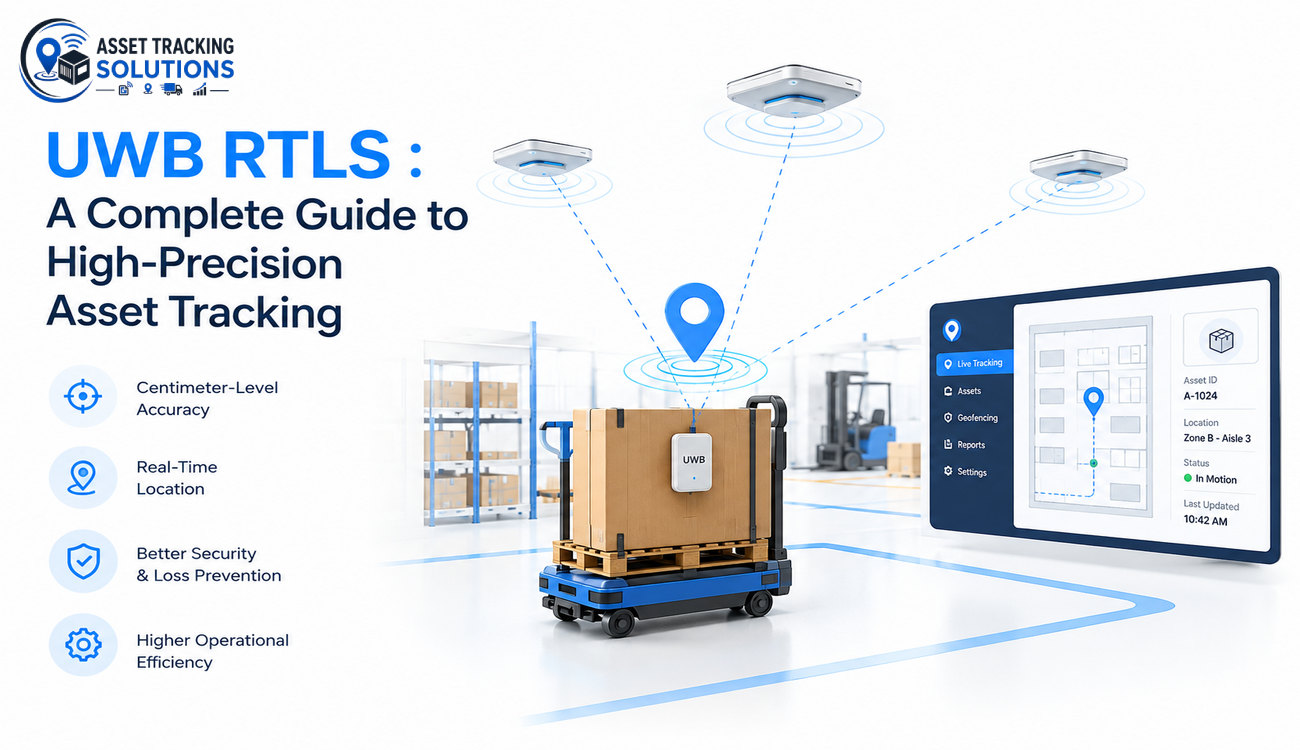
UWB RTLS is a real-time location tracking technology that uses Ultra-Wideband radio signals to determine the position of tagged objects, equipment, or people within a specific environment. The system generally consists of UWB tags attached to tracked assets, fixed anchors or reference points installed throughout a facility, and location software that processes positioning data.
The technology operates by transmitting short-duration radio pulses across a wide frequency bandwidth. By measuring the time required for signals to travel between devices, a UWB-based positioning system can estimate distances and calculate an asset’s location. Depending on the hardware, positioning technique, installation conditions, and system configuration, the solution can achieve accuracy at the centimeter level.
Unlike GPS, which relies on satellite signals and is generally unsuitable for precise indoor positioning, UWB can operate effectively inside warehouses, factories, hospitals, and other enclosed environments when sufficient anchors and suitable radio coverage are available.
The primary purpose of UWB RTLS is to provide reliable location visibility for operational decisions. Instead of searching manually for equipment or relying on outdated inventory records, employees can view asset positions through a centralized dashboard and respond more quickly to changing requirements.
How Does UWB RTLS Work?
An UWB-based tracking system works through communication between wireless tags and strategically positioned anchors. These components collect positioning measurements and send the necessary information to a location engine, which calculates coordinates and displays them in a software interface.
UWB Tags and Asset Identification
UWB tags are compact wireless devices attached to assets that require continuous or periodic tracking. These tags transmit signals that allow the system to estimate their positions. Depending on the design, tags may be battery-powered, rechargeable, or integrated into specialized equipment.
Each tag is associated with a unique asset record, enabling the tracking platform to connect location information with details such as equipment type, maintenance history, department, and ownership. This makes it easier for organizations to identify the physical location of an asset and understand its operational status.
Anchors and Positioning Infrastructure
Anchors are fixed reference devices installed at selected locations throughout a building or operational site. They receive signals from UWB tags or participate in two-way ranging exchanges, depending on the system architecture. The positioning engine uses measurements from multiple reference points to estimate the tag’s coordinates.
Anchor placement is an important part of deployment because walls, metal structures, machinery, and other obstructions can affect radio propagation. A carefully planned installation helps maintain positioning reliability across different zones and reduces potential coverage gaps.
Location Calculation and Software Integration
The location engine processes signal measurements using techniques such as Time of Flight (ToF), Two-Way Ranging (TWR), or Time Difference of Arrival (TDoA). The appropriate method depends on the application, infrastructure, synchronization requirements, and device capabilities.
Once calculated, location data is transmitted to the tracking application through a suitable network or gateway. Employees can then view asset positions on digital floor plans, configure geofences, review movement history, and integrate location information with existing enterprise systems.
Key Benefits of UWB RTLS for Asset Tracking
High-Precision Indoor Positioning
One of the most important advantages of UWB technology is its ability to support highly accurate indoor positioning. Depending on deployment conditions, suitable hardware, and system configuration, UWB systems can achieve accuracy within approximately 10–30 centimeters, although actual performance varies by environment.
This level of precision helps employees locate specific tools, components, and equipment without searching entire rooms or warehouse sections. It is especially valuable in facilities where several similar assets are stored close together or where operational workflows depend on exact positioning.
Improved Asset Utilization
Businesses often purchase additional equipment because existing assets are difficult to locate or their availability is unclear. Real-time location visibility helps organizations identify underused resources, monitor equipment movement, and allocate assets according to actual demand.
By improving equipment visibility, UWB RTLS can help reduce unnecessary purchases, minimize idle time, and support more effective resource planning.
Reduced Search Time and Operational Delays
Searching for misplaced equipment can interrupt production schedules, delay patient care, and slow warehouse operations. A high-precision tracking system allows employees to locate assets through a centralized interface instead of contacting multiple departments or conducting manual searches.
The resulting time savings can improve workflow continuity and allow staff to focus on higher-value responsibilities.
Better Security and Loss Prevention
Location monitoring can help organizations identify when valuable assets move outside authorized areas or enter restricted zones. Geofencing rules can trigger alerts when equipment crosses predefined boundaries, allowing responsible teams to investigate unexpected movement.
Although tracking does not eliminate theft or unauthorized access, it improves visibility and supports faster responses to potential asset loss.
Data-Driven Operational Decisions
Historical location records reveal how equipment moves through a facility, where bottlenecks occur, and which assets remain idle for extended periods. Managers can analyze these patterns to improve layout planning, streamline workflows, and identify opportunities for operational improvement.
UWB RTLS vs. Other Asset Tracking Technologies
Different tracking technologies serve different operational needs, and the best choice depends on required accuracy, deployment conditions, asset volume, and budget.
UWB vs. RFID
RFID is widely used for inventory identification, item-level tracking, and automated movement recording. Passive RFID tags are generally inexpensive and do not require their own batteries, making the technology suitable for tracking large quantities of products.
However, conventional RFID systems are often designed to identify items within a reader’s coverage area rather than continuously determine their precise coordinates. UWB is more appropriate when a business needs accurate, real-time indoor positioning of individual assets.
UWB vs. Bluetooth Low Energy
Bluetooth Low Energy (BLE) provides an economical option for tracking assets across buildings and facilities. It can support proximity detection, room-level location services, and broader monitoring applications.
UWB generally offers greater positioning precision, while BLE may be more suitable when affordability, battery life, and large-scale deployment are the primary priorities. Some organizations combine both technologies to balance cost and accuracy.
UWB vs. GPS
GPS is widely used for outdoor fleet tracking, vehicle monitoring, and location-based applications across large geographic areas. However, satellite signals may be unreliable or unavailable inside buildings.
UWB is designed for precise positioning within instrumented indoor environments, making it a stronger option for factories, hospitals, warehouses, and distribution centers. Organizations operating across both indoor and outdoor areas may benefit from a hybrid tracking architecture.
Industry Applications of UWB RTLS
Manufacturing and Industrial Facilities
Manufacturing plants use UWB tracking to monitor tools, production equipment, work-in-progress materials, and mobile machinery. Knowing the location of essential resources can reduce production interruptions and help supervisors understand how assets move between workstations.
In complex industrial environments, location information can also support workflow analysis, equipment utilization reporting, and integration with manufacturing execution systems.
Healthcare and Hospitals
Hospitals frequently manage large inventories of wheelchairs, infusion pumps, diagnostic devices, patient beds, and other mobile equipment. Staff may spend considerable time searching for available devices across departments.
UWB-based tracking helps healthcare facilities locate equipment more precisely, monitor movement between authorized areas, and improve equipment availability. When appropriately designed, it can support operational efficiency while preserving patient privacy and complying with applicable data protection requirements.
Warehousing and Logistics
Warehouses depend on the timely movement of pallets, containers, handling equipment, and high-value inventory. UWB tracking can improve visibility into the location of selected assets and help teams coordinate material movement across storage and dispatch zones.
Integrating location data with a warehouse management system can further improve asset allocation, exception handling, and operational planning.
Automotive and Aerospace
Automotive and aerospace facilities handle specialized tools, components, vehicles, and high-value assemblies that often move through complex production environments. Accurate location information can help teams identify equipment, monitor material movement, and improve coordination between operational stages.
These applications are particularly useful when asset location must be known with greater precision than conventional proximity-based tracking can provide.
How to Implement UWB RTLS in Your Business
Successful implementation begins with a clear understanding of the operational problem rather than simply selecting hardware. Businesses should identify which assets require tracking, what level of positioning accuracy is necessary, and how location information will improve existing processes.
Define Tracking Requirements
Start by identifying the assets that create the greatest operational challenges. These might include expensive equipment, frequently misplaced tools, mobile medical devices, or components moving between production stages.
Determine whether the application requires continuous tracking, periodic location updates, movement history, restricted-zone alerts, or integration with other operational systems. These requirements will guide decisions about tags, infrastructure, and software.
Assess the Facility and Positioning Environment
Evaluate the facility layout, building materials, equipment density, and potential radio obstructions. A site survey can help determine suitable anchor locations and identify areas where signal reflections or blocked paths may affect positioning performance.
For large or complex facilities, testing a representative zone before full deployment helps establish realistic accuracy expectations and infrastructure requirements.
Select the Right Hardware and Software
Choose tags based on asset type, mounting requirements, battery life, durability, and operating conditions. Anchors should support the required positioning method and provide adequate coverage throughout the target area.
The software platform should offer useful features such as digital floor maps, asset search, historical tracking, alerts, reporting, and access controls. Integration capabilities are also important when location data must be shared with enterprise resource planning, warehouse management, or maintenance platforms.
Run a Pilot and Validate Performance
A pilot deployment allows the organization to test location accuracy, update frequency, tag battery consumption, network reliability, and user experience under real operating conditions.
Compare the results with predefined performance targets before expanding the system. Pilot findings can also reveal opportunities to improve anchor placement, software configuration, and employee workflows.
Scale and Continuously Optimize
After validating the pilot, expand the deployment in stages and train employees to use the tracking platform effectively. Establish procedures for tag maintenance, device replacement, software updates, and data access.
Regularly evaluate tracking performance and operational outcomes to ensure the solution continues to meet business requirements as the facility and asset inventory evolve.
Challenges and Considerations Before Deployment
Despite its advantages, UWB technology requires thoughtful planning. Infrastructure costs can be higher than those of basic BLE or barcode-based systems because precise indoor positioning often requires multiple anchors, compatible tags, and location-processing software.
Environmental conditions also matter. Metal structures, signal reflections, obstacles, and poor anchor placement can affect accuracy. Businesses should validate performance within the actual operating environment instead of relying exclusively on laboratory specifications.
Power management is another consideration because frequent tag transmissions and location updates may increase battery consumption. Organizations must balance tracking frequency against battery life, maintenance requirements, and operational needs.
Finally, integration and data governance should be addressed early. Connecting location information to enterprise applications requires reliable interfaces, appropriate access controls, and clear policies for collecting, retaining, and using tracking data.
The Future of High-Precision Asset Tracking
The future of indoor asset tracking will increasingly involve connected sensors, intelligent analytics, automation, and digital representations of physical facilities. UWB positioning can contribute to these developments by providing accurate spatial information that complements other operational data sources.
When integrated with IoT platforms, asset management software, and analytics tools, location data can help organizations identify recurring delays, understand equipment utilization, and improve resource allocation. In selected applications, it can also support automated workflows that respond to asset movement or the presence of equipment within designated zones.
Advances in UWB hardware, integration capabilities, and deployment methods may make high-precision tracking more accessible to organizations across different industries. However, the greatest value will come from connecting location data to clearly defined operational goals rather than treating tracking as an isolated technology investment.
Conclusion
High-precision asset tracking has become increasingly important for businesses that need better visibility, stronger operational control, and more efficient resource utilization. UWB technology provides a practical way to determine the location of valuable assets within indoor environments, helping organizations reduce search time, improve equipment availability, and make more informed decisions.
By combining appropriate tags, strategically positioned anchors, reliable location software, and integration with existing business systems, organizations can develop a tracking solution that supports their operational requirements. Careful planning, pilot testing, and continuous optimization remain essential to achieving dependable results.
For businesses exploring advanced asset visibility, UWB RTLS can be a valuable component of a broader digital transformation strategy. The right implementation can turn location data into actionable insights, helping teams manage resources more effectively and build more responsive, data-driven operations.
FAQs
Q1. What is UWB RTLS used for?
UWB RTLS is used to track the real-time location of assets, equipment, tools, and other valuable resources with high precision. It is commonly used in manufacturing, healthcare, warehousing, logistics, and automotive facilities to improve asset visibility, reduce search time, and optimize resource utilization.
Q2. How accurate is UWB RTLS technology?
UWB RTLS can achieve positioning accuracy of approximately 10–30 centimeters in suitable environments, depending on the hardware, anchor placement, signal conditions, and system configuration. This precision makes it suitable for applications that require more detailed indoor location information than conventional proximity-based tracking systems.
3. How does UWB RTLS differ from RFID tracking?
RFID is primarily used to identify and track tagged items as they pass through reader zones, making it suitable for inventory management and automated identification. UWB RTLS focuses on determining the precise location of assets in real time. The choice depends on whether a business needs item identification, continuous positioning, or a combination of both capabilities.
4. What are the main benefits of UWB RTLS for businesses?
UWB RTLS helps businesses locate assets quickly, improve equipment utilization, reduce operational delays, and monitor movement across designated areas. It can also support geofencing alerts, historical movement analysis, and better resource planning when integrated with asset management and enterprise software.
5. What factors should businesses consider before implementing UWB RTLS?
Businesses should evaluate positioning accuracy requirements, facility layout, anchor placement, tag battery life, infrastructure costs, and software integration needs. Conducting a site survey and testing a pilot deployment can help validate system performance, identify potential signal obstructions, and ensure the solution meets operational requirements before full-scale implementation.