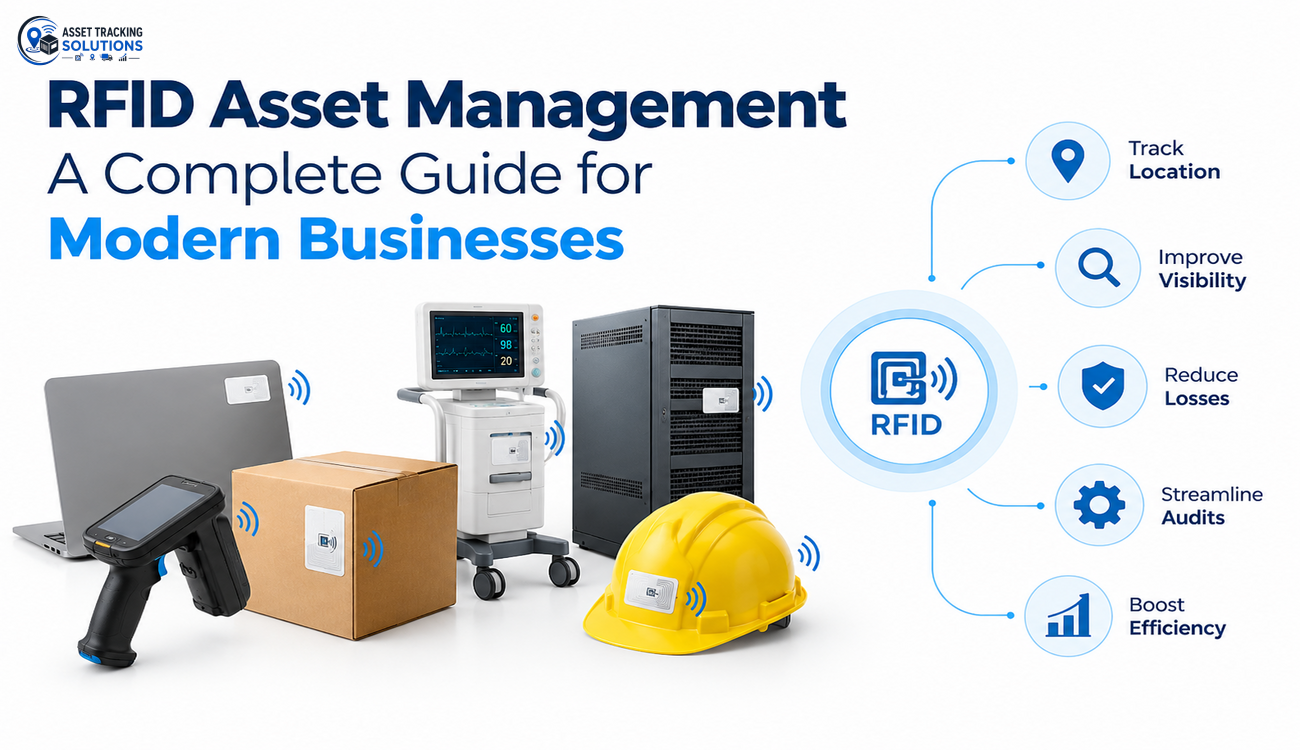
Modern businesses manage a growing number of physical assets, including IT equipment, industrial machinery, medical devices, warehouse tools, vehicles, and office supplies. Keeping track of these assets becomes increasingly challenging as organizations expand their operations, move equipment between locations, and rely on multiple teams to manage inventory. Traditional asset tracking methods, such as spreadsheets, barcodes, and manual registers, often create data gaps, increase administrative work, and make it difficult to identify the exact location of valuable resources. RFID Asset Management for Business has become an important consideration for organizations looking to automate asset identification, improve accountability, and maintain accurate records across multiple departments.
Radio Frequency Identification (RFID) technology offers a smarter approach to asset tracking by allowing businesses to identify and monitor tagged items using radio waves. Unlike traditional barcode systems, RFID does not always require direct line of sight to read a tag, making asset identification faster and more convenient. With the right combination of RFID tags, readers, and asset management software, organizations can improve visibility, reduce asset loss, and make better operational decisions.
What is RFID Asset Management?
RFID asset management is a technology-driven approach to identifying, tracking, and managing physical assets through radio frequency identification. The system uses RFID tags attached to assets, RFID readers that capture tag information, and software that processes the collected data to provide useful information about asset identity, location, movement, and status.
Each RFID tag contains a unique identifier that can be associated with an asset record in a centralized database. When a reader detects the tag, the system retrieves the associated information, helping authorized employees identify equipment without manually entering asset numbers or scanning each item individually.
RFID Asset Management for Business enables organizations to maintain more consistent asset records while reducing the effort required for routine inspections and inventory verification. Depending on the system configuration, businesses can use fixed readers at entry points, handheld readers for physical audits, or specialized readers installed in operational areas.
The technology can support asset management throughout the asset lifecycle, from procurement and registration to maintenance, relocation, and retirement.
How Does RFID Asset Management Work?
An RFID asset management system operates through communication between RFID tags, readers, antennas, and software. Each component performs a specific function, and their combined operation allows businesses to collect asset information with less manual intervention.
RFID Tags for Asset Identification
RFID tags are attached to physical assets to provide a digital identity that can be read by compatible RFID equipment. Tags may be passive, active, or battery-assisted, depending on the tracking requirements and operating environment.
Passive RFID tags receive energy from the reader’s radio signal and are commonly used for inventory and equipment identification. Active RFID tags contain a battery and can support longer-range identification or specialized location-tracking applications. The appropriate tag depends on the asset’s material, size, environment, required reading distance, and expected lifespan.
RFID Readers and Data Collection
RFID readers communicate with tags and capture their identification data. Handheld readers are useful for asset audits, maintenance inspections, and locating tagged equipment within a facility. Fixed readers can automatically detect tagged assets moving through designated doorways, storage areas, or checkpoints.
Reader performance depends on factors such as tag placement, antenna configuration, surrounding materials, radio frequency, and environmental interference. Careful configuration helps improve reading accuracy and reduces missed or unintended reads.
Asset Management Software
The software connects RFID identification data with detailed asset records, including asset type, assigned department, purchase date, maintenance history, and current status. It can also compare expected asset locations with recorded movements and flag exceptions for investigation.
RFID Asset Management for Business becomes more valuable when RFID readers are integrated with existing enterprise systems, such as Enterprise Resource Planning (ERP), Computerized Maintenance Management Systems (CMMS), warehouse management platforms, or IT asset management software. This integration helps organizations maintain consistent information across their operational workflows.
Key Benefits of RFID Asset Management for Modern Businesses
Improved Asset Visibility
Knowing where equipment is located is essential for organizations that manage assets across departments, warehouses, offices, or multiple facilities. RFID technology can capture asset movements at configured checkpoints and simplify periodic location verification.
With RFID Asset Management for Business, employees can access updated asset records and identify discrepancies more efficiently. Better visibility can reduce time spent searching for equipment and help teams make existing resources available when needed.
Faster and More Accurate Asset Audits
Traditional asset audits often involve checking individual labels, recording serial numbers, and comparing physical assets against spreadsheets. This process can become time-consuming when hundreds or thousands of items must be verified.
RFID readers can identify multiple compatible tags within a reading area, allowing organizations to complete inventory checks more efficiently. Although accuracy depends on environmental conditions and system design, automated identification can reduce manual data-entry errors and improve audit consistency.
Reduced Asset Loss and Misplacement
Missing equipment can create unexpected replacement costs, operational delays, and accountability challenges. RFID technology helps organizations maintain better records of asset movements and identify discrepancies between expected and observed locations.
When RFID readers are installed at relevant access points, businesses can configure alerts for certain movement events. RFID Asset Management for Business can therefore support loss prevention by helping teams investigate unusual movements and strengthen asset-handling procedures.
However, RFID identification alone does not guarantee real-time location tracking or prevent theft. Those capabilities depend on the selected hardware, reader coverage, software configuration, and associated security controls.
Better Maintenance Planning
Industrial machinery, medical equipment, and other critical assets require regular inspections and preventive maintenance. Missing maintenance records or uncertainty about equipment availability can affect productivity and service quality.
An RFID-enabled asset management platform can associate equipment identification with maintenance schedules, inspection results, and service history. Maintenance teams can identify assets due for inspection and access relevant records more easily, supporting better planning and reducing avoidable administrative delays.
Improved Operational Efficiency
Manual asset management requires employees to spend time searching for equipment, updating records, verifying inventory, and preparing reports. Automating parts of these activities allows teams to focus on more valuable operational tasks.
RFID Asset Management for Business can also improve coordination between procurement, finance, operations, facilities, and maintenance teams by giving them access to consistent asset information. This shared visibility helps organizations make more informed decisions about equipment allocation, replacement, and utilization.
Common Applications of RFID Asset Management
Manufacturing and Industrial Facilities
Manufacturing businesses use RFID to identify tools, production equipment, reusable containers, and other operational assets. RFID readers can capture tagged items moving between designated workstations or storage areas, helping teams improve equipment accountability and reduce delays caused by missing resources.
Integration with maintenance or production systems can also connect asset identification with service records and operational workflows.
Healthcare and Hospitals
Hospitals manage medical devices, diagnostic equipment, mobile carts, and other valuable resources that frequently move between departments. RFID can simplify equipment identification and support inventory verification across clinical and nonclinical areas.
An RFID-based system can help staff locate equipment more efficiently, monitor its recorded movement, and maintain better asset records. Healthcare organizations must still consider equipment compatibility, cleaning requirements, patient privacy, and possible radio frequency interference with sensitive medical devices.
Warehousing and Logistics
Warehouses rely on tools, handling equipment, reusable transport containers, and other assets to maintain efficient operations. RFID can automate identification at selected locations and help organizations verify asset transfers between storage areas and facilities.
When integrated with warehouse management software, RFID Asset Management for Business can support improved inventory visibility, asset accountability, and coordination across logistics workflows.
IT and Office Asset Management
Businesses often manage laptops, monitors, networking equipment, printers, and other office technology across multiple departments. RFID tags can help identify these assets during audits, employee onboarding, equipment reassignment, and office relocations.
A centralized platform can connect each tagged asset with its assigned user or department, purchase information, and service history. Organizations should combine RFID tracking with appropriate access controls and data protection policies.
RFID Asset Management vs. Barcode Asset Tracking
RFID and barcode technologies both support asset identification, but they differ in how information is captured.
Barcode systems generally require a scanner to read a visible label, and each item usually needs to be presented individually. RFID systems can read multiple tags within a reader’s coverage area without requiring direct visual access to each tag.
RFID may be more suitable for organizations that conduct frequent large-scale audits, manage high asset volumes, or need automated movement detection at specific checkpoints. Barcode systems can remain a practical and cost-effective choice for businesses with smaller inventories or simpler tracking requirements.
The right decision depends on the number of assets, labor costs, required tracking frequency, operating environment, and expected return on investment. Some organizations benefit from using both technologies for different asset categories.
How to Implement RFID Asset Management Successfully
Define Business Requirements
Before selecting hardware or software, businesses should identify their primary asset management challenges. These may include missing equipment, slow audits, inaccurate records, poor maintenance visibility, or limited accountability across locations.
Clear objectives help determine the required reading range, asset categories, reporting capabilities, and integration requirements.
Select the Right RFID Tags and Readers
Tag selection should reflect the physical characteristics of the assets and the environment in which they operate. Metal surfaces, liquids, temperature variations, and electromagnetic interference can influence RFID performance.
Organizations should test representative assets before deployment and choose compatible readers, antennas, and tags based on actual operating conditions.
Integrate RFID with Asset Management Software
RFID hardware provides identification data, but software turns that data into useful business information. The platform should support centralized asset records, movement history, audit reporting, user permissions, and relevant integrations.
RFID Asset Management for Business should also include clear rules for updating asset ownership, location, status, and maintenance information so that records remain reliable over time.
Conduct a Pilot Before Scaling
A pilot project allows organizations to test reading accuracy, evaluate workflow changes, identify integration issues, and measure operational improvements before expanding the deployment.
Businesses should establish baseline measurements and compare them with pilot results, including audit time, asset discrepancies, missing equipment incidents, and employee effort.
Train Employees and Monitor Performance
Successful implementation depends on employees understanding how assets are tagged, moved, assigned, and maintained within the system. Training should cover standard operating procedures, exception handling, and data accuracy.
Regular reviews help identify gaps in reader coverage, incorrect asset records, and opportunities to improve workflows as the business grows.
Challenges and Considerations in RFID Asset Management
Although RFID offers several advantages, implementation requires careful planning. Hardware, tags, software licenses, integration, and infrastructure can increase initial costs, particularly for large deployments.
Reading performance can vary because of metal surfaces, liquids, tag orientation, interference, and facility layout. Businesses may need specialized tags or adjusted reader configurations for challenging environments.
Data security is another consideration. Organizations should implement suitable access controls, secure system integrations, and clear policies for asset information. They should also distinguish between detecting an RFID tag within a reader’s range and determining an asset’s precise real-time location, as these are different capabilities.
A well-planned deployment addresses these factors through testing, employee training, technical validation, and ongoing performance monitoring.
Future Trends in RFID Asset Management
RFID asset management is evolving alongside the growth of the Internet of Things (IoT), cloud computing, artificial intelligence, and connected enterprise systems. Modern platforms increasingly combine identification data with analytics to provide better visibility into asset usage, movement patterns, and operational performance.
Integration with IoT sensors can add contextual information, such as temperature or environmental conditions, when supported by compatible devices. AI-powered analytics may help identify unusual movement patterns, underutilized equipment, or maintenance trends when sufficient reliable data is available.
Cloud-based platforms can also support asset visibility across multiple facilities, while mobile applications make asset records easier to access for employees working outside centralized offices.
These developments are making RFID Asset Management for Business more adaptable to organizations seeking connected, data-driven asset operations. However, the value of emerging capabilities depends on data quality, system integration, security, and a clearly defined business objective.
Conclusion
Effective asset management is essential for controlling costs, improving productivity, and maintaining operational continuity. As organizations grow, manual tracking methods can become difficult to maintain, especially when assets move frequently between departments, facilities, and operational environments.
RFID technology provides a practical way to automate asset identification, simplify audits, improve movement visibility, and maintain more consistent records. When supported by appropriate hardware, reliable software, employee training, and well-defined workflows, it can help businesses make better use of their existing resources.
For organizations evaluating RFID Asset Management for Business, the most effective approach is to begin with clear operational goals, select technology suited to the environment, and validate the results through a pilot deployment. With the right implementation strategy, RFID can become a valuable part of a modern asset management system that supports long-term efficiency, accountability, and informed decision-making.
FAQs
Q1. What is RFID asset management for business?
RFID asset management for business is a system that uses radio frequency identification technology to track, identify, and manage physical assets. It combines RFID tags, readers, and asset management software to improve asset visibility, simplify inventory audits, reduce misplaced equipment, and maintain accurate asset records across departments and locations.
Q2. How does RFID asset management work?
RFID asset management works by attaching RFID tags to physical assets and using compatible readers to capture their unique identification data. The asset management software connects this information with records such as location, ownership, maintenance history, and status, helping businesses monitor assets and automate routine tracking activities.
Q3. What are the main benefits of RFID asset management?
The main benefits include faster asset audits, improved inventory accuracy, reduced asset loss, better equipment utilization, simplified maintenance planning, and increased operational efficiency. RFID also reduces the need for manual data entry and helps organizations maintain consistent asset information across multiple facilities and departments.
Q4. Which industries can benefit from RFID asset management?
Manufacturing, healthcare, logistics, warehousing, retail, construction, and IT departments can benefit from RFID asset management. These industries use RFID to track machinery, medical devices, tools, reusable containers, office equipment, and other valuable resources, improving accountability and asset visibility throughout their operations.
Q5. How can a business implement an RFID asset management system?
A business can implement an RFID asset management system by identifying its tracking requirements, selecting suitable RFID tags and readers, choosing compatible asset management software, and integrating the system with existing business applications. Conducting a pilot project, training employees, and monitoring performance metrics can help ensure a successful and cost-effective implementation.