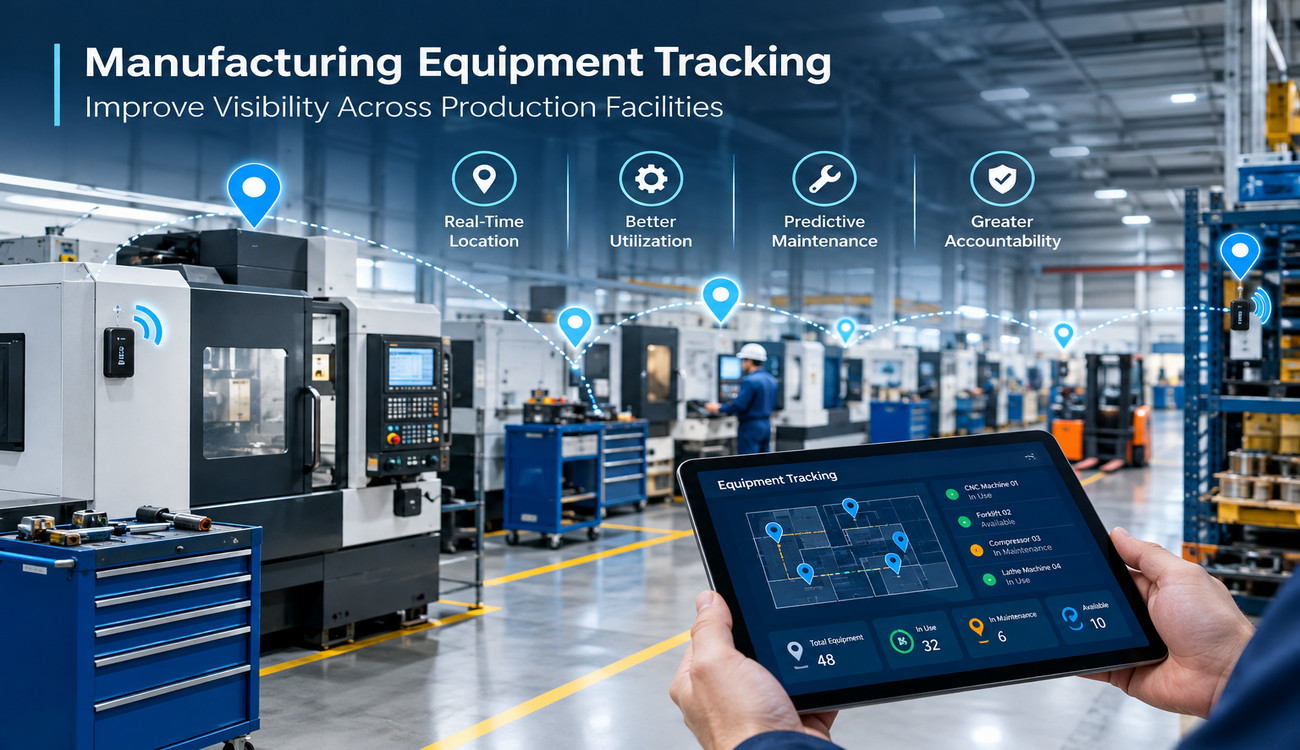
Manufacturing facilities depend on a wide range of equipment to maintain continuous production, from heavy machinery and assembly-line systems to tools, mobile equipment, inspection devices, and maintenance assets. As production environments become larger and more complex, knowing where equipment is located, whether it is available, and how effectively it is being used becomes increasingly difficult. Manual registers, spreadsheets, and disconnected monitoring systems often leave teams with incomplete or outdated information. Manufacturing Equipment Tracking provides a structured way to improve visibility across production facilities by helping organizations monitor equipment location, movement, utilization, availability, and operational status.
With technologies such as RFID, IoT sensors, barcode systems, BLE, GPS, and connected software platforms, manufacturers can create a more accurate view of their physical assets. This visibility can support better production planning, faster maintenance response, improved asset utilization, and stronger operational control.
What is Manufacturing Equipment Tracking?
Manufacturing Equipment Tracking refers to the use of digital identification and monitoring technologies to track equipment throughout a manufacturing environment. Depending on the facility and equipment type, manufacturers may use RFID tags, barcode labels, BLE beacons, IoT sensors, GPS devices, or combinations of these technologies.
The objective is not simply to identify an asset. A modern tracking system can provide information about where equipment is located, when it moved, who or which process is using it, whether it is available, and whether it requires maintenance. This creates a connected information layer between physical equipment and business systems.
For example, if a specialized production tool is required for an upcoming manufacturing order, employees should not have to search several production areas or contact different departments to determine its location. A digital tracking platform can provide the relevant equipment information and help teams locate the asset more efficiently.
Why Equipment Visibility Matters in Manufacturing
Manufacturing operations often involve hundreds or thousands of physical assets distributed across production lines, warehouses, maintenance areas, testing zones, and storage facilities. Equipment may also move between facilities or departments based on changing production requirements.
When asset information is inaccurate, employees can spend valuable time searching for equipment, production schedules can be affected, and maintenance teams may struggle to identify the correct asset history. Better visibility helps organizations understand what equipment they have, where it is, and how it is being used.
How Manufacturing Equipment Tracking Improves Production Visibility
One of the most important advantages of digital equipment tracking is the creation of a reliable source of asset information. Instead of depending entirely on manual records, organizations can collect equipment data automatically and make it available through centralized software.
Real-Time Location Awareness
Knowing the current location of equipment can be particularly important in large production facilities. Equipment may move between workstations, storage areas, maintenance departments, quality-control zones, and different production halls throughout the day.
With RFID readers, BLE systems, or IoT-enabled tracking devices, manufacturers can capture equipment movements and update location information within a centralized platform. This helps employees determine where an asset was last detected and reduces unnecessary searching.
Improved Equipment Utilization
Manufacturers invest significant amounts of capital in production equipment, tools, and supporting assets. However, ownership alone does not guarantee efficient utilization.
A tracking system can provide information about how frequently equipment is being used, where it spends most of its time, and whether certain assets remain idle for extended periods. These insights can help managers identify underused equipment and make more informed decisions about allocation, procurement, or redistribution.
Better Maintenance Coordination
Equipment availability directly affects production continuity. If maintenance teams do not have accurate information about an asset, diagnosing problems and scheduling service can become more complicated.
Digital tracking can connect equipment identification with maintenance records, inspection schedules, service history, and operational information. When an asset requires attention, maintenance personnel can more easily identify the equipment and access relevant information before beginning the service process.
Technologies Used for Equipment Tracking
Different manufacturing environments require different tracking technologies. The right approach depends on facility size, equipment type, tracking accuracy requirements, environmental conditions, and the level of automation required.
RFID-Based Tracking
RFID is widely used for identifying and tracking physical assets without requiring direct line-of-sight scanning. RFID tags can be attached to equipment, tools, containers, and other assets, while readers positioned at strategic locations capture movement information.
In manufacturing environments, RFID can help monitor equipment movement between production areas and provide automated identification at checkpoints. It can be especially useful where large numbers of assets need to be monitored regularly.
IoT Sensors and Connected Equipment
IoT technology can extend tracking beyond location. Connected sensors can capture information such as temperature, vibration, operating conditions, usage patterns, and equipment status.
When this information is combined with location data, manufacturers can develop a broader understanding of asset performance. This can support predictive maintenance strategies and help teams identify unusual equipment behavior before it develops into a larger operational issue.
BLE and Indoor Location Technologies
Bluetooth Low Energy can support indoor asset tracking where GPS is unsuitable. BLE beacons and tags can provide location information within warehouses, production halls, and other indoor environments.
For facilities that need more precise location awareness, BLE can be integrated with indoor positioning systems to help determine where equipment is located within specific operational zones.
Barcode and QR-Based Identification
Barcode and QR-code systems remain useful where organizations need an affordable and straightforward identification method. Employees can scan equipment using mobile devices or dedicated scanners to record movement, inspection, maintenance, or allocation information.
Although barcode systems typically require manual scanning, they can be effective for facilities where real-time automated tracking is not necessary for every asset.
Key Benefits Across Production Facilities
Implementing digital equipment visibility can influence several areas of manufacturing operations. The value is particularly noticeable when tracking information is connected with existing enterprise systems and operational workflows.
Reducing Equipment Search Time
Employees can lose considerable time searching for shared tools, mobile machinery, inspection equipment, and other production assets. Digital location information can reduce this unnecessary activity by providing a clearer view of where equipment is located.
This allows employees to spend more time on production, maintenance, quality, and other value-generating activities.
Supporting Production Planning
Production planning depends on the availability of the right resources at the right time. Equipment tracking can provide planners with more accurate information about asset availability and location.
When equipment is already allocated to another production line or undergoing maintenance, planners can identify the situation earlier and adjust schedules accordingly.
Improving Asset Accountability
Equipment can move between teams, production lines, facilities, and contractors. Without proper tracking, responsibility for equipment can become unclear.
A centralized system can maintain records of asset assignments and movements, helping organizations establish greater accountability while reducing the risk of equipment being misplaced.
Enhancing Inventory and Asset Records
Manufacturing organizations often maintain separate records for production equipment, maintenance assets, tools, and operational inventory. These fragmented records can create inconsistencies.
Connecting tracking information with an asset management platform can create a more consistent digital record. Equipment identification, location, maintenance status, ownership, and usage information can be managed through a centralized environment.
Integrating Tracking With Existing Manufacturing Systems
The effectiveness of an equipment tracking solution depends heavily on integration. A standalone tracking system may provide location information, but its value increases when that information becomes part of broader manufacturing workflows.
ERP Integration
Integration with an ERP platform can connect equipment information with procurement, finance, inventory, maintenance, and operational processes. This can help organizations maintain better asset records while reducing duplicate data entry.
MES and Production System Integration
Manufacturing Execution Systems manage important production activities. Connecting equipment tracking with MES platforms can provide production teams with better awareness of equipment availability and allocation.
This connection can also support more accurate production reporting by associating equipment information with specific production processes.
Maintenance Management Integration
Integrating tracking data with computerized maintenance management systems can improve visibility into maintenance activities. Teams can connect physical assets with service schedules, work orders, inspection records, and maintenance history.
This creates a stronger relationship between equipment location and equipment condition, helping maintenance teams work with more complete information.
Challenges to Consider Before Implementation
Although digital tracking can improve manufacturing visibility, implementation requires careful planning. Facilities differ significantly in layout, operating conditions, equipment types, and technology infrastructure.
Selecting the Right Tracking Technology
No single technology is suitable for every manufacturing environment. RFID may be effective for automated identification, BLE may be better suited to indoor location monitoring, while IoT sensors may be necessary for condition monitoring.
Manufacturers should evaluate the required level of location accuracy, environmental conditions, asset value, movement patterns, and operational objectives before selecting a technology.
Data Accuracy and System Integration
Tracking systems are only useful when the information they provide is reliable. Incorrect asset records, missing tags, poor reader placement, or disconnected software systems can reduce the quality of tracking information.
Organizations should therefore establish clear asset identification standards and integration processes before expanding the system across the facility.
Employee Adoption
Technology implementation also changes how employees interact with equipment and operational systems. Workers may need to scan assets, use mobile applications, respond to alerts, or follow new equipment-handling procedures.
Training and simple workflows can help ensure that employees understand how the system supports their daily responsibilities.
Building a Scalable Equipment Visibility Strategy
A successful Manufacturing Equipment Tracking strategy should generally begin with a clearly defined operational problem rather than attempting to track every asset immediately. Organizations can start with high-value equipment, frequently misplaced tools, mobile machinery, or assets that directly influence production continuity.
After establishing the initial tracking process, manufacturers can measure improvements in search time, utilization, equipment availability, maintenance response, and asset accountability. The solution can then be expanded to additional asset categories and facilities based on measurable operational requirements.
Using Analytics for Continuous Improvement
The information collected through tracking systems can become valuable operational data. Historical movement, utilization, maintenance, and availability records can reveal patterns that are difficult to identify through manual observation.
Manufacturers can analyze this information to identify bottlenecks, underutilized equipment, recurring maintenance issues, and inefficient asset movement. Over time, these insights can support better resource planning and continuous operational improvement.
The Future of Equipment Visibility in Manufacturing
The future of Manufacturing Equipment Tracking is increasingly connected to automation, artificial intelligence, digital twins, and predictive analytics. Instead of simply answering where an asset is located, future systems can combine location, usage, condition, production schedules, and historical data to provide more intelligent operational insights.
AI-powered analytics can help identify unusual equipment behavior and predict potential maintenance requirements. Digital twin environments can provide virtual representations of production facilities and assets, allowing organizations to visualize equipment movement and operational conditions.
As smart manufacturing environments continue to evolve, equipment visibility will increasingly become part of a broader connected manufacturing ecosystem.
Conclusion
Manufacturing facilities cannot operate efficiently when teams lack reliable information about critical equipment. Searching for assets, working with outdated records, managing maintenance manually, and dealing with unclear equipment ownership can create unnecessary operational friction.
Manufacturing Equipment Tracking provides manufacturers with a structured way to connect physical assets with digital information. By combining RFID, IoT, BLE, barcode, and software integration, organizations can improve equipment visibility, utilization, maintenance coordination, and operational accountability.
The most effective approach is to begin with specific business challenges, select technology based on actual facility requirements, integrate tracking information with existing systems, and expand the solution as measurable value is demonstrated. As manufacturing becomes increasingly connected, accurate equipment visibility can serve as an important foundation for more efficient, data-driven production operations.
FAQs
Q1. What is Manufacturing Equipment Tracking?
Manufacturing Equipment Tracking is the use of technologies such as RFID, IoT, BLE, barcodes, and connected software to monitor equipment location, movement, availability, utilization, and status across production facilities. It helps manufacturers maintain accurate asset records and improve operational visibility.
Q2. How does equipment tracking improve manufacturing operations?
Equipment tracking helps manufacturers quickly identify where assets are located and whether they are available, in use, or under maintenance. This can reduce equipment search time, improve resource allocation, support production planning, and provide better accountability across departments.
Q3. Which technologies are used for tracking manufacturing equipment?
Common technologies include RFID, BLE, GPS, barcode and QR codes, IoT sensors, and indoor positioning systems. The appropriate technology depends on factors such as facility size, equipment type, required tracking accuracy, environmental conditions, and operational requirements.
Q4. Can equipment tracking integrate with ERP and maintenance systems?
Yes. Modern tracking solutions can integrate with ERP, MES, CMMS, and other enterprise platforms. This allows equipment location and identification data to connect with inventory, production, maintenance, procurement, and asset-management workflows.
Q5. What should manufacturers consider before implementing equipment tracking?
Manufacturers should evaluate the types of equipment being tracked, required location accuracy, facility layout, environmental conditions, integration requirements, data quality, and employee workflows. Starting with high-value or frequently misplaced equipment can provide a practical foundation for broader implementation.