
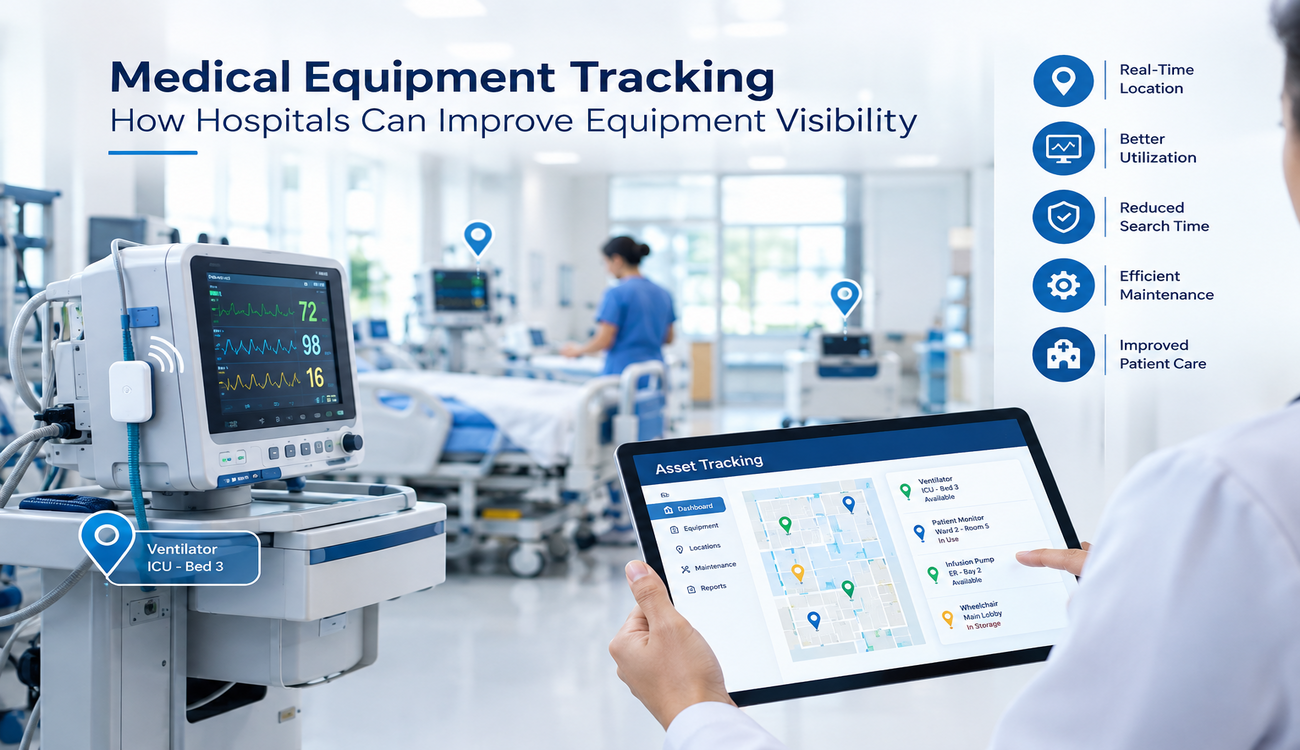
Hospitals depend on a wide range of medical equipment every day, from infusion pumps and patient monitors to wheelchairs, ventilators, diagnostic devices, and mobile treatment units. Medical Equipment Tracking helps healthcare facilities improve visibility into these critical assets, making it easier to know where equipment is located and whether it is available when needed. However, many hospitals still face challenges in locating devices, monitoring their movement, and understanding whether valuable equipment is being properly utilized.
As hospitals become larger and healthcare operations become more complex, maintaining clear visibility into medical assets is becoming increasingly important. Equipment can move between departments, treatment rooms, operating areas, storage facilities, and emergency units throughout the day. Without an effective visibility system, staff may spend valuable time searching for devices that are already available somewhere within the facility.
Modern tracking technologies can help hospitals create a more connected asset environment. By combining technologies such as RFID, Bluetooth Low Energy, Internet of Things sensors, real-time location systems, and centralized software platforms, healthcare organizations can monitor equipment movement, availability, utilization, and location with greater accuracy.
Why Equipment Visibility Matters in Modern Hospitals
Medical Equipment Tracking plays an important role in helping healthcare organizations manage their valuable assets effectively. Medical equipment represents a significant investment for hospitals, but purchasing these devices is only one part of the process. Healthcare facilities also need to ensure that equipment remains accessible, properly maintained, and efficiently distributed across different departments. Better visibility can help staff locate essential devices faster while supporting more organized and cost-effective asset management.
Poor visibility can create several operational problems. A nurse may spend several minutes searching for an infusion pump, while another department may have unused devices sitting in a storage area. Similarly, equipment may be transferred between departments without proper records, making it difficult for staff to determine its current location.
These seemingly small inefficiencies can accumulate throughout the day. When healthcare professionals spend less time searching for equipment, they have more time to focus on patients and clinical responsibilities.
The Hidden Cost of Unavailable Equipment
Equipment that cannot be located quickly can create unnecessary operational costs. Hospitals may purchase additional devices because existing assets appear to be unavailable, even though they are simply misplaced or being underutilized.
This can result in unnecessary capital expenditure and increased maintenance requirements. Medical Equipment Tracking allows administrators to understand how assets are being used and identify equipment that may be underutilized, overused, or unnecessarily concentrated in a particular department.
Supporting Faster Clinical Operations
Healthcare environments often require quick access to equipment. During emergencies, staff cannot afford to spend excessive time searching corridors, storage rooms, or neighboring departments for essential devices.
A centralized visibility system can provide staff with information about where an asset was last detected or where it is currently located, depending on the technology being used. This can help reduce search time and improve the overall flow of clinical operations.
How Hospitals Can Improve Equipment Visibility
Improving equipment visibility requires more than simply attaching a tracking tag to an asset. Hospitals need to consider their facility layout, equipment categories, workflows, technology infrastructure, and operational requirements before implementing a tracking solution.
The objective should be to create a connected environment where equipment information can be accessed by authorized personnel without introducing unnecessary complexity into daily workflows.
RFID-Based Identification and Tracking
RFID technology can help healthcare organizations identify and monitor tagged equipment as it moves through different areas. RFID tags can be attached to suitable medical devices, while readers positioned at strategic locations can capture movement information.
This approach can be useful for monitoring equipment transfers between departments, identifying assets entering or leaving designated areas, and improving inventory accuracy. Unlike manual recording, automated identification can reduce the amount of effort required from hospital staff.
Medical Equipment Tracking can be particularly valuable in hospitals where large numbers of mobile assets constantly move between rooms, departments, and treatment areas.
Real-Time Location Systems
Real-time location systems can provide more detailed information about the location of mobile equipment within a healthcare facility. Depending on the selected technology, systems may use Bluetooth Low Energy, Wi-Fi, ultra-wideband, or other positioning technologies.
A location dashboard can provide authorized staff with a visual representation of equipment across different hospital zones. This makes it easier to determine whether a device is available nearby or located in another department.
For hospitals with complex facilities, this level of visibility can support faster asset retrieval and more efficient resource allocation.
IoT Sensors for Connected Equipment
IoT-enabled equipment can provide additional information beyond basic location. Connected sensors can help organizations monitor factors such as movement, environmental conditions, usage patterns, and operational status when supported by the equipment and integration architecture.
This information can help hospitals understand how equipment is being used throughout its lifecycle. For example, utilization data may reveal that certain devices are frequently requested in one department while remaining idle in another.
When combined with location information, Medical Equipment Tracking and IoT data can create a more complete picture of asset performance.
Medical Equipment Tracking: Creating a Centralized Visibility Layer
Medical Equipment Tracking enables hospitals to bring asset location and movement information into a centralized digital environment. Instead of relying on manual searches, spreadsheets, paper records, or disconnected departmental systems, healthcare teams can use a technology-enabled platform to access relevant equipment information from a single interface.
The effectiveness of such a system depends on integrating tracking technology with hospital workflows. Equipment records can include information such as asset identification, department assignment, location history, maintenance status, and availability.
Creating a Single Source of Asset Information
A centralized platform can help healthcare administrators establish a consistent view of equipment across the organization. Instead of maintaining separate records for different departments, asset information can be consolidated into a common system.
This can improve coordination between clinical teams, biomedical engineering departments, facilities teams, and administrators. When everyone works from more reliable asset information, decisions about equipment allocation and procurement can become more informed.
Improving Asset Utilization
Visibility also helps hospitals understand whether their existing equipment is being fully utilized. Historical data can reveal patterns in equipment movement and demand.
For example, if one department consistently has excess equipment while another regularly experiences shortages, administrators may be able to redistribute assets instead of purchasing additional devices.
Medical Equipment Tracking can help healthcare organizations maximize the value of existing investments while reducing unnecessary purchases.
Using Data to Improve Maintenance and Compliance
Equipment visibility should not stop at knowing where a device is located. Hospitals also need to know whether equipment is safe, maintained, and ready for use.
Supporting Preventive Maintenance
Tracking systems can be integrated with maintenance records to help biomedical engineering teams identify equipment requiring inspection, calibration, servicing, or repair.
When equipment location and maintenance information are connected, technicians can spend less time locating devices and more time performing maintenance activities.
This can contribute to better asset availability and help hospitals establish more structured maintenance workflows.
Maintaining Better Equipment Records
Accurate equipment records are essential for healthcare organizations managing large asset inventories. A digital system can maintain information about asset ownership, department assignment, movement history, maintenance events, and status.
Better records can support internal audits and help administrators make more informed decisions throughout the equipment lifecycle.
Integrating Visibility With Hospital Systems
A successful implementation should fit into the hospital’s existing technology environment rather than operating as an isolated platform. Integration with healthcare applications, enterprise systems, maintenance software, dashboards, and other operational platforms can provide a more connected experience.
Connecting Tracking Data With Existing Workflows
Integration allows asset information to become part of existing operational processes. For example, equipment status may be displayed through an administrative dashboard, while maintenance teams can access relevant information through their existing service workflows.
Medical Equipment Tracking reduces the need for staff to switch between multiple systems and makes equipment information more actionable.
Creating Role-Based Visibility
Not every employee needs access to the same information. Clinical staff may need to locate available equipment, while administrators may require utilization reports and maintenance teams may need service information.
Role-based access can help ensure that each user receives the information relevant to their responsibilities while maintaining appropriate control over operational data.
Challenges Hospitals Should Consider
Technology alone does not guarantee successful asset visibility. Hospitals should carefully evaluate their environment before selecting a solution.
Large healthcare facilities may contain thick walls, multiple floors, restricted areas, electromagnetic interference, and constantly changing workflows. These factors can affect the performance of certain tracking technologies.
Hospitals should also consider tag durability, battery requirements, network coverage, system scalability, data security, integration capabilities, and user adoption.
Selecting the Right Technology
Different assets and environments may require different technologies. RFID may be suitable for identification and movement detection, while BLE or other location technologies may be more appropriate for continuous indoor positioning.
The right approach to Medical Equipment Tracking depends on the hospital’s operational objectives, facility structure, equipment types, and required level of location accuracy.
Ensuring Staff Adoption
Healthcare workers already operate under demanding conditions. A new system should make their work easier rather than create additional administrative tasks.
Simple interfaces, automated data collection, clear workflows, and appropriate training can improve adoption. Hospitals should involve relevant departments during implementation so that the system reflects real operational requirements.
The Future of Hospital Asset Visibility
Healthcare organizations are moving toward increasingly connected and data-driven environments. As IoT, AI, analytics, and real-time location technologies continue to develop, hospitals can gain more opportunities to optimize the way equipment is managed.
Future systems may use historical utilization data and predictive analytics to anticipate equipment demand, identify potential shortages, recommend asset redistribution, and support proactive maintenance planning.
The combination of location intelligence and analytics can also help hospital leaders understand broader operational patterns. Instead of simply asking where an asset is, organizations can begin asking how efficiently it is being used, where demand is increasing, and how equipment resources should be allocated.
Conclusion
Better equipment visibility can have a meaningful impact on hospital operations. When healthcare organizations know where their mobile assets are, how they are being used, and whether they are available or undergoing maintenance, staff can make faster and more informed decisions.
Medical Equipment Tracking uses technologies such as RFID, IoT, BLE, and real-time location systems to help hospitals improve equipment visibility. When these technologies are connected with centralized software and existing healthcare workflows, they can reduce search time, improve asset utilization, strengthen maintenance processes, and support better resource planning.
For hospitals looking to improve operational efficiency without continually increasing their equipment inventory, creating a connected and transparent asset environment can be an important step toward smarter healthcare operations.
Frequently Asked Questions
Q1. What is medical equipment tracking?
Medical equipment tracking is a technology-enabled approach that helps hospitals monitor the location, movement, availability, and status of medical assets. Technologies such as RFID, BLE, IoT, and real-time location systems can provide hospitals with better visibility and help staff locate equipment more efficiently.
Q2. How can hospitals improve medical equipment visibility?
Hospitals can improve equipment visibility by using RFID tags, IoT sensors, real-time location systems, and centralized asset management software. These technologies can provide information about equipment locations and movement while helping administrators understand utilization and availability across different departments.
Q3. What types of hospital equipment can be tracked?
Hospitals can track many mobile and high-value assets, including infusion pumps, wheelchairs, patient monitors, ventilators, diagnostic devices, beds, portable medical equipment, and other movable healthcare assets. The appropriate tracking technology depends on the equipment type and the hospital’s operational requirements.
Q4. How does equipment tracking help reduce hospital costs?
Equipment tracking can help reduce costs by improving asset utilization and reducing unnecessary equipment purchases. When hospitals have better visibility into existing assets, administrators can identify underutilized equipment, redistribute resources between departments, and make more informed procurement decisions.
Q5. Can equipment tracking systems integrate with existing hospital software?
Yes, modern equipment visibility solutions can often integrate with existing hospital systems, maintenance platforms, dashboards, and enterprise applications. Integration allows equipment information to become part of existing workflows and gives authorized staff easier access to relevant asset data.