Managing and locating physical assets has become increasingly challenging as businesses handle thousands of equipment, tools, products, containers, and other valuable items across multiple locations. Traditional tracking methods such as spreadsheets, manual registers, barcodes, and periodic audits can make it difficult to know where an asset is, who is using it, or whether it is available when needed. RFID Asset Tracking provides a more automated approach by using radio frequency identification technology to identify, monitor, and manage assets with less manual intervention.
RFID-based tracking can help businesses improve asset visibility, reduce losses, speed up inventory processes, and maintain more accurate records. Unlike traditional barcode systems, RFID tags can often be identified without direct line-of-sight, allowing organizations to track multiple tagged assets more efficiently. This makes RFID particularly useful for industries where large volumes of assets need to be monitored regularly.
What is RFID Asset Tracking?
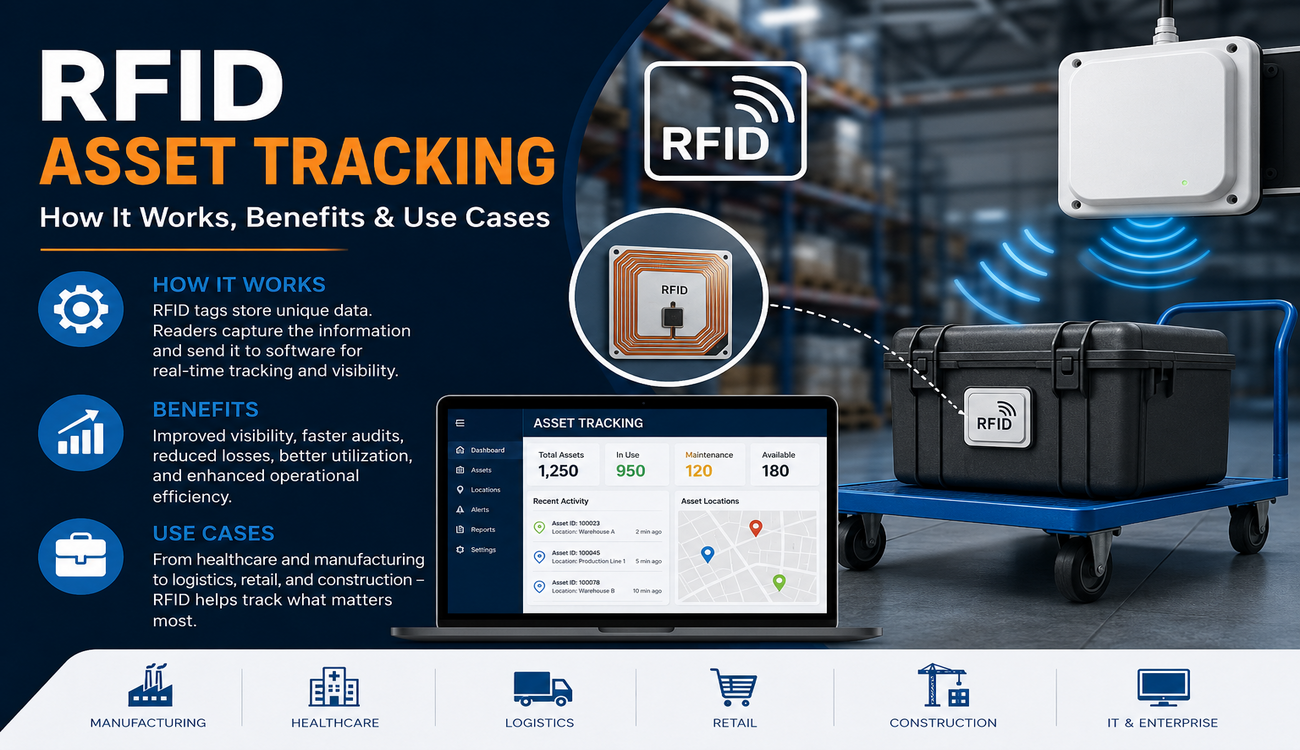
RFID Asset Tracking is a technology-based method of monitoring and managing physical assets using RFID tags, RFID readers, antennas, and tracking software. Each asset is assigned an RFID tag containing a unique identification number. When the tag comes within the operating range of an RFID reader, the reader captures the tag information and sends it to an asset tracking platform or database.
The system can then associate the RFID tag with information about the asset, such as its name, type, location, status, department, assigned employee, maintenance history, or purchase details. This creates a digital record that can be updated as the asset moves between locations.
For example, a manufacturing company may attach RFID tags to tools and equipment used across different production areas. Instead of manually checking each item, employees can use RFID readers to identify tagged equipment and update its location or status within the asset management system.
How Does RFID Asset Tracking Work?
The basic operation of an RFID tracking system involves several connected components that work together to identify and monitor assets.
RFID Tags
An RFID tag is attached to or embedded in an asset. It contains a unique identifier that allows the system to distinguish one asset from another. Depending on the application, businesses can use passive RFID tags that receive power from the reader’s signal or active RFID tags that have their own power source and can support longer-range tracking.
The choice of tag depends on factors such as asset type, required read range, operating environment, tag durability, and tracking requirements.
RFID Readers and Antennas
RFID readers communicate with RFID tags using radio frequency signals. When a tagged asset enters the reader’s coverage area, the reader detects the tag and collects its identification information.
Antennas help transmit and receive the radio signals between readers and tags. Multiple antennas can be installed in strategic locations such as warehouse entrances, storage areas, production zones, loading docks, or facility checkpoints.
RFID Asset Tracking Software
The RFID reader sends captured tag information to the tracking software, where it can be processed and connected with the organization’s asset database. The software provides visibility into asset records and can help users determine which assets are available, where they were last detected, and how they are being used.
Advanced systems can also integrate RFID data with ERP, inventory management, warehouse management, maintenance, or enterprise asset management platforms.
Data Processing and Real-Time Visibility
Once RFID information reaches the software platform, organizations can use it to create a centralized view of their assets. Depending on the system configuration, users may receive automated updates when assets enter or leave designated areas.
This can help organizations reduce manual data entry and create more reliable asset movement records. With appropriate reader placement and system configuration, businesses can monitor asset movements across predefined zones and improve operational visibility.
Key Benefits of RFID Asset Tracking
RFID technology can provide significant operational advantages for organizations that manage large numbers of physical assets.
Improved Asset Visibility
One of the biggest advantages is improved visibility. Businesses can maintain digital records of their assets and identify where equipment or inventory was last detected. This can be particularly valuable when assets are distributed across warehouses, offices, production facilities, or multiple sites.
Better visibility also makes it easier for employees to determine whether an asset is available before searching for it manually.
Faster Inventory and Asset Audits
Manual asset audits can require employees to inspect equipment individually and compare physical records with spreadsheets or databases. RFID can significantly reduce the amount of manual work involved.
Readers can detect multiple RFID tags within their operating range, allowing organizations to identify groups of assets much faster than manually recording individual items. This can make periodic inventory verification more efficient and reduce the time required for audits.
Reduced Asset Loss and Misplacement
Lost and misplaced assets can create unnecessary replacement costs and operational delays. RFID tracking can help organizations identify asset movements and improve accountability.
When an asset is detected at a particular location, the system can update its record. Businesses can also establish alerts or monitoring rules for specific movement patterns, helping teams identify potentially unauthorized or unexpected asset movements.
Better Asset Utilization
Organizations often purchase expensive equipment without having a clear picture of how frequently each asset is being used. RFID-generated tracking data can provide greater insight into asset availability and movement.
This information can help managers identify underused equipment, frequently used assets, and potential opportunities to redistribute resources instead of purchasing additional equipment unnecessarily.
Improved Operational Efficiency
Employees can spend considerable time searching for equipment, verifying asset records, and completing manual documentation. Automating these processes can reduce repetitive administrative work.
With better asset visibility, employees can spend less time searching and more time performing their core responsibilities, improving overall operational efficiency.
Better Maintenance Management
RFID can also support maintenance workflows by connecting asset identification with maintenance records. When a tagged asset is scanned or detected, employees can access information about its maintenance schedule, service history, or current status.
This can help organizations improve preventive maintenance processes and reduce the risk of equipment being overlooked.
RFID Asset Tracking Use Cases Across Industries
RFID technology can be applied to many industries because organizations across sectors need reliable ways to identify, locate, and manage physical assets.
Manufacturing
Manufacturing companies manage machinery, tools, components, work-in-progress materials, and maintenance equipment across production environments. RFID can help identify assets as they move between workstations, storage areas, and production lines.
Tracking tools and equipment can also help reduce downtime caused by employees searching for essential resources. Maintenance teams can use RFID-linked records to access asset information and support scheduled servicing.
Healthcare
Hospitals and healthcare facilities manage medical equipment, wheelchairs, infusion pumps, surgical instruments, patient-care equipment, and other high-value assets. Finding the right equipment quickly can be important for operational efficiency.
RFID tracking can provide healthcare organizations with better visibility into equipment locations and availability. It can also help reduce unnecessary purchases when existing equipment is available but difficult to locate.
Warehousing and Logistics
Warehouses and logistics companies often manage large volumes of inventory, reusable containers, pallets, tools, and handling equipment. RFID can help automate asset identification at receiving areas, storage zones, dispatch points, and other operational locations.
The technology can improve visibility across asset movements and reduce the dependence on manual tracking processes.
Construction
Construction companies frequently move expensive tools, machinery, equipment, and materials between project sites. Because assets may be distributed across multiple locations, maintaining accurate records can be difficult.
RFID can help construction businesses monitor tagged equipment and improve accountability. Tracking records can also help managers understand where equipment is being used and whether it needs to be transferred between projects.
Retail
Retail organizations can use RFID to improve inventory visibility across stores, warehouses, and distribution centers. Tagged products and equipment can be identified more efficiently, helping businesses maintain more accurate stock information.
RFID can also support faster stock checks and improve visibility into product movement throughout the supply chain.
IT and Enterprise Asset Management
Large organizations often manage laptops, servers, networking equipment, monitors, mobile devices, and other IT assets. RFID can help organizations maintain accurate asset records and monitor equipment across offices and facilities.
By connecting RFID information with an asset management platform, IT teams can maintain better records of asset ownership, location, status, and lifecycle information.
RFID vs. Barcode Asset Tracking
RFID and barcode systems are both widely used for identification and tracking, but they operate differently. Barcode systems generally require the scanner to have a clear line of sight to the barcode, and assets typically need to be scanned individually.
RFID, on the other hand, uses radio frequency communication and can identify tags without the same direct line-of-sight requirement. Depending on the RFID system and environment, multiple tags can also be detected within a reader’s range.
This does not mean RFID is always a replacement for barcodes. The right technology depends on the organization’s budget, asset types, read-range requirements, operating environment, tracking volume, and business objectives.
Challenges to Consider Before Implementing RFID
Although RFID can improve asset visibility and automation, organizations should evaluate several factors before deployment. RFID performance can be affected by materials, environmental conditions, reader placement, tag selection, and interference.
Businesses also need to determine which assets require tracking, where readers should be installed, what type of tags are appropriate, and how RFID data will connect with existing software systems.
A successful implementation therefore requires more than simply attaching RFID tags to assets. Organizations need proper planning, system configuration, testing, integration, and employee training to achieve reliable results.
How to Implement RFID Asset Tracking Successfully
A practical implementation should begin by identifying the organization’s most important asset tracking challenges. Businesses should determine which assets are most valuable, frequently misplaced, difficult to locate, or operationally critical.
The next step is selecting suitable RFID tags, readers, antennas, and software based on the operating environment. A pilot deployment can help organizations test read accuracy, reader placement, tag performance, and integration requirements before expanding the system across the organization.
Integration is another important consideration. Connecting RFID data with existing inventory, ERP, warehouse, maintenance, or asset management systems can create a more centralized source of asset information.
Organizations should also establish clear processes for tagging new assets, updating asset records, managing damaged tags, and handling asset transfers. These processes help ensure that the RFID system continues to provide accurate information after deployment.
The Future of RFID Asset Tracking
The future of RFID Asset Tracking is closely connected with automation, IoT, cloud platforms, artificial intelligence, and real-time analytics. As businesses seek greater visibility into physical operations, RFID data can become part of larger digital infrastructure.
Integration with IoT platforms can allow organizations to combine RFID identification with sensor information such as temperature, movement, or environmental conditions. Cloud-based platforms can make asset information accessible across multiple locations, while analytics can help organizations identify patterns in asset utilization and movement.
As these technologies continue to develop, RFID is likely to become an increasingly important component of connected asset management environments.
Conclusion
RFID Asset Tracking provides businesses with a practical way to improve how physical assets are identified, monitored, and managed. By combining RFID tags, readers, antennas, and tracking software, organizations can reduce manual tracking, improve asset visibility, accelerate audits, reduce losses, and make better use of existing equipment.
From manufacturing and healthcare to logistics, construction, retail, and IT, RFID can support a wide range of asset management requirements. However, achieving the best results requires careful planning, appropriate hardware, reliable software integration, and processes designed around the organization’s specific operational needs.
As businesses continue moving toward connected and data-driven operations, RFID can serve as an important foundation for creating more efficient, visible, and automated asset management systems.
FAQs
Q1. What is RFID Asset Tracking?
RFID Asset Tracking is a technology that uses RFID tags, readers, antennas, and tracking software to identify, monitor, and manage physical assets. It helps businesses improve asset visibility and reduce manual tracking.
Q2. How does RFID Asset Tracking work?
An RFID tag is attached to an asset and contains a unique identification number. When the tag enters the range of an RFID reader, the reader captures its information and sends it to tracking software, which records the asset’s location and status.
Q3. What are the benefits of RFID Asset Tracking?
RFID Asset Tracking can help businesses improve asset visibility, speed up inventory audits, reduce asset loss, improve equipment utilization, automate tracking processes, and support better maintenance management.
Q4. Which industries use RFID Asset Tracking?
RFID Asset Tracking is used across manufacturing, healthcare, logistics, warehousing, construction, retail, IT, and other industries that need to monitor equipment, inventory, tools, or high-value assets.
Q5. Is RFID better than barcode tracking?
RFID can offer advantages over barcodes because tags generally do not require direct line-of-sight and multiple tags can potentially be detected at once. However, the best option depends on the organization’s assets, environment, budget, and tracking requirements.